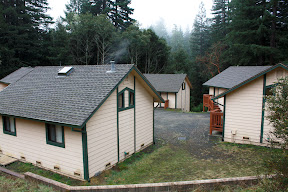
10-Day Vipassana Christmas Course (Occidental, CA)

One Hundred Forty Nine Female Meditators; Ninety Seven Male Meditators; Twenty One Kitchen Staff; Seven Course Managers; Four Assistant Teachers; One Big Video Screen.

The photo to the left doesn't quite capture the magnitude of a hall seating more than 250 meditators. So, let me try to put it into words - messy, but well disciplined - crowded but cooperative - long lines, but loud laughter too - snoring dormitories, but shared experience. Add to this the extra ingredient of a special once a year Christmas holiday-time course to bring people together and make for a thriving 10 day community in the woods of Occidental.

For anyone thinking of attending this course, which has a been ongoing now for several years, I will share some highlights of this year's experience.

The course ended this morning, and I'm typing this now on a foggy winter day, but the weather was sunny and bright for most of the course. There was not a drop of rain this year. This probably made the shoe-room more friendly (less muddy) when entering the hall for both group sits and meals. Yes, the dining hall and meditation hall were in the same building! A office cubicle type partition separated the two and a white cloth separated the women's dining hall from the men's.

Accommodations were tight; women were often left in the bathroom line while the next group sit had already begun. Cushions were close in the hall. Walking the dining room with a full tray of vipassana food was like a dance to avoid bumping one another. The kitchen staff worked nearly non stop through the course keeping a constant load of clean dishes ready for use.

The dormitories had six bunk beds, so provided space for twelve meditators. This made for wonderful antics such as the battle to control the heater and the three windows. Every night, the room temperature was different as we slept. (Note that this was in spite of the posted sign stating: Please ask a manager to adjust the heat). The first few nights I woke up in a hot sweat. But, since I probably not the only one, somebody opened a window and soon it was more like the 40 degree weather outside.

Each person had a distinctive way of either slamming the door with a bang or slowly guiding it closed with a whisper. A number of my dorm-mates were sleep talkers which provided amusement for the insomniacs. I suppose it could have been really bad, but I actually enjoyed sharing in such an intimate experience with them all.

There were not very long walking paths, but enough to get the heart pumping if you wanted to. The food was delicious, as usual, following similar recipes to the North Fork vipassana center.

Very few people left the course before the end, which seemed to be a good sign. All together it didn't have the cushy luxury of the North Fork center, but provided a fun setting for a special holiday. Christmas was on Day six, and I could not think of a better way to spend it.

Perhaps the best part is that when the course was over, we were able to break all the rules (since we were no longer on official vipassana course land). This meant that on Day 11, we gave hugs goodbye, and one guy played his melodious Indian raga flute for us all. Physical touch and music of any kind are always prohibited at course centers. I like breaking rules, especially with flute music in the forest on a cold foggy morning.

Learning More About Actualism

I've mentioned the practice of actualism to some friends and so put together this list of links for them to discover more about the practice. The website can be a bit confusing, and often off-putting to people at first.

Here is the practice in a nutshell:
http://actualfreedom.com.au/library/topics/method.htm

I think this quote sums up the intention of the practice pretty well, and it is from perhaps the most detailed and technical explanation of the technique - presented in the article, "Attentiveness and Sensuousness and Apperceptiveness". This article gives a more detailed explanation of how to practice the method outlined in the previous link.
http://actualfreedom.com.au/richard/articles/attentivenesssensuousnessapperceptiveness.htm
"The intent is you will become happy and harmless. The intent is you will be free of sorrow and malice. The intent is you will become blithesome and benign. The intent is you will be free of fear and aggression. The intent is you will become carefree and considerate. The intent is you will be free from nurture and desire. The intent is you will become gay and benevolent. The intent is you will be free of anguish and animosity. The intent is that, by being free of the Human Condition you will experience peace-on-earth, in this life-time, as this body..." - Richard
Also, I recommend the Library for searching general topics of interest, and it also provides a link to the FAQ page:
http://actualfreedom.com.au/library

For someone who may be less interested in the technical details but would enjoy a fun introductory tour, this link could be useful:
http://actualfreedom.com.au/introduction/universe.htm

Enjoy, and be happy.

A Big Huggin' Apology

I haven't written in a while, it's true. Perhaps you'll find it in your heart to forgive me. Or, if not, then just look at the cute baby pictured here until you start giggling.

It may be that I didn't have much that I wanted to write over the last few months, but also I probably forgot how useful this blog has been for keeping in touch with the multitude of great people I meet in life.

OK. Perhaps for a come-back post I might just write a little bit about what has been going on for me. I went on another meditation retreat last August at the North Fork Vipassana Center, and I'm headed to Occidental in a couple weeks for the 10-day Christmas course in the Goenka tradition.

I haven't been practicing the Goenka technique so much, however. I had a great conversation with Daniel Ingram, author of "Mastering The Core Teachings Of The Buddha," and I guess I'd say I'm practicing meditation now in a way most similar to his particular teachings. Of course, he isn't so specific on what he recommends, he places more of an emphasis on the basic understanding (the three characteristics of anicca, anatta, and dukkha) and doing whatever one knows best to give 100% attention to these characteristics from moment-to-moment in each moment again and again. Well, that's my paraphrasing anyway. If you want to know more, you can read his (hardcore) Dharma book.

Other than meditation, I have been devoting a great deal of effort to the practice of Actualism - a technique which has as its specific goal: happiness, harmlessness, peace on Earth, and the end of delusion. These are the questions which stay at or near the forefront of my mind: In short, how to live with the sensibility to live peacefully and happily with my fellow humans.

I've also been taking classes at a local community college with the intent to build a new career. Many of the topics I've been studying have been directly relevant to life as well. I finally took General Psychology, which is funny since I've already learned so much about psychology indirectly anyway. As a side note, I find it fascinating how new this science is. Many of the discoveries of psychology have come only in the last century or two, and it's clear that there are still many errors in the current mainstream of psychological thought. If I had more of a disposition toward academia and research, I might try my hand at contributing to this developing field.

As for this physical world of trees, cars, people, clouds and such, I have continued to explore and discover: I just made it through a wild once-in-a-decade windstorm here in California. I discovered a Japanese mini-mall in my extended neighborhood. I heard the dribbling trickling sound of waves rolling across pebbles at Wilder Ranch State Park. I watched one heat of the O'Niells Cold Water Classic surf contest. And, of course I can't just be an observer, so I jumped in the cold ocean of Santa Cruz a few times too.

I think I will try to write more here. Things have changed a lot for me (as things tend to do) but part of the fun of blogging must be to see the evolution of thoughts and events through time.

Back To The Cushion

Well, after a lot of fun with family, friends, and close companions during the holidays... I'm now returning to the cushion for some more meditation. Two things are on my agenda. First, I've signed up for another Goenka retreat at the North Fork Vipassana Center in early February. It's been a while since I've been on formal retreat, so this should be fun! And Second, I've started working with a new meditation teacher, Kenneth Folk. He really seems to fit for where I'm at and what my goals are right now. I'm finding it much easier to understand the technique with his guidance and to really know exactly what I'm doing and how to best use my time.

So, I'm back on the cushion and practicing with a gusto. I will probably post more soon on how things progress.

Wonderful

Sensousness in Every Moment

I'm sitting in the library, enjoying a cold Tuesday in California, and this is what's on my mind - Sensuousness.

Here's the definition I use for sensuousness (taken from The Free Dictionary

"Highly appreciative of the pleasures of sensation."

This library has a soft yellow tone across the walls, floors, and the faces of the people around me. The yellow comes from the buzzing florescent bulbs overhead, evenly spaced across the ceiling. The columns of the library's structure are painted purple, which gives a bright contrast to the yellow - though even these walls are subject to the cast of florescent light.

What does it mean to see? What is it to see color?

In contemplating the idea of beauty, I'm tempted to ask why certain wavelengths of visible light would be considered more "beautiful" in certain arrangements than other wavelengths. How radical that there is even a wavelength at all. A vibration hits my retina creating the visual sense. The amount of wiggle in this vibration is defined in terms of wavelength, frequency, etc. Light is wiggling my retina. This is sensuousness - the joy of being wiggled.

Every moment, my senses are attentive. Input is being received and processed. The sound of my fingers clicking keys on my keyboard ride over the soft sounds of librarians voices, swiping bar-codes on the library checkout machines, a photocopy machine making rhythmic sweeps behind me.

I open my senses - panoramic. Dropping the specifics, I tune into the pleasure of sensing in and of itself. This sensing is every moment. This sensing is a dazzling symphony of sensory changes.

As humans, most of us are aware that each moment of our life is never to be repeated. Each moment is "the moment of a lifetime." Each is unique, fleeting, and never to come again. And yet, with each passing moment, we are still "here," it is still "now." How do we spend these moments?

What are you doing right now? I'm typing on my keyboard, listening softly to the sounds around me. Whatever it is that we may be doing... right now sensuousness is available. The pleasure of sensing itself, which is the pleasure of actuality. The pleasure of being a sensate being in intimacy with our physical surroundings.

Sensuousness is intimacy, and sensuousness is the window into the perfection of this universe. Sensuousness is what makes the actuality of this physical universe so ultimately satisfying. Sensuousness can't be imagined, and can't be found in any fantasy. It is only available here and now... but in this very moment it is available in abundance.

Enjoy your holidays.

- Daniel

A Bias Toward The Facts

I've come to a thrilling conclusion which may be reflected in my blog writing from now on and perhaps in my personality as well. The conclusion I've come to is a clear and unequivocal preference for... the facts. (Ah, it's nice to say.)

I know that Albert Einstein was quoted as saying “imagination is more important than knowledge,” and I am now clearly standing up to say “not for me, it isn't.” This may come as a surprise to some who know me because that used to be one of my favorite quotes. And, perhaps if one wants to win the Nobel prize for theoretical physics, then maybe “imagination is more important than knowledge.” I'm not interested in winning any prizes for my theories however, so I will stick to the facts.

So far what my experience shows is that for the sake of living a happy and harmonious life, for living peacefully with myself and with others, and for living in this world with some degree of sense and sensibility, then facts are most important and imagination is not even useful. Wow. I said it. And that's a fact.

To introduce my bias more formally, I will refer to that excellent resource – the dictionary - to elaborate a bit.
Fact (dictionary.com) 
 /fækt/
–noun
1. something that actually exists; reality; truth: Your fears have no basis in fact.

2. something known to exist or to have happened: Space travel is now a fact.

3. a truth known by actual experience or observation; something known to be true: Scientists gather facts about plant growth.
Facts have many advantages, given that they exist regardless of our opinions, beliefs, theories, and stances on them. What a relief it is to discover something so dependable. A fact is indisputable given that it is so easily confirmed through one's sensory experience. What a relief to discover such consistency. And, a fact is nothing personal, so there's no need to take offense.

One of the most challenging facts for a human being, is the fact of our own mortality. We are all going to die. But, look... it's dependable, it's consistent, it's indisputable, and bottom line... it's nothing personal. Hmmm...

Here's another fact:
Two-hundred and fifty million year-old bacteria, Bacillus permians, were revived from stasis after being found in sodium chloride crystals in a cavern in New Mexico... it is the oldest living thing ever recorded.

A Great Basin Bristlecone Pine (Pinus longaeva) called Prometheus was measured by ring count at 4,862 years old when it was felled in 1964. This is the greatest verified age for any living organism at the time of its killing.

- wikipedia
Certainly, the facts will continue to make an appearance here on this blog as I continue to explore this whole business called being alive. I invite you to join me in welcoming the facts, and perhaps we can explore together. What a wonder it is to be alive. Yet, there it is, a plain fact, as plain as day... we are alive now. And, there's no arguing that.

Cushion Report: November Noting Practice

I spent the last few days on meditation retreat at home with the intention to do rigorous noting practice (vipassana) morning to night with a bigger picture goal of trying to solve this human condition I find myself in. This is an edited report of what I experienced and some things I noticed in the practice. Hopefully it may be of some use to someone out there reading it, or if you have a comment to add, please let me know.

With regards to the noting practice specifically, I was inspired a phrase I read recently: “keep going with this single-minded no-brains-required noting task,” from a meditation teacher named Tarin. After reading that, I decided to try a dumbed-down noting practice... to really suck all the brains out of it, so to speak... just to see what would happen. I liked the initial results and decided to give it a test run on a three-day retreat.

My formal noting practice moves incredibly slow, as I find the actual skill of creating verbal notes in my mind to be one which probably must be developed like a muscle. I would say that I was able to note at a rate of about 1-2 notes per second for about 60% of the day on day 1. That number fell to about 30% of the day on day 2, and about 40% of the day on day 3. The rate never went much slower than 1-2 per second, unless I got restless, tense, or stressed in which case I would lose focus so much that I would slow down as much as to 1 per 10 minutes or so. But, luckily my actualism practice has really cut back the amount of time I spend being restless, tense or stressed. And, that enabled me to enjoy the process enough to be able to maintain this more rapid noting pace (1-2 per second). Any attempt to go faster than 2 per second usually resulted in a blur where I would again lose focus and my noting would have no correlation to what was actually being experienced.

That was for what I might call my “formal” or “conscious” noting practice. Now, also in the “background” so to speak, I was often noticing at a rate of perhaps 10-20 per second. And what I mean by that is that, given all the mindfulness training I've already done, my mind sometimes automatically becomes mindful of experience at a very rapid pace. But, I could hardly say that “I was noting.” It seems more accurate to say that experience arises and I notice it with some clarity and precision at a rate of about 10-20 notices per second. Perhaps I could call this “noticing” practice. This is more of a background, and automatic awareness practice that seems like a blend of Goenka and a lot of the other awareness stuff I've done in the past.

Overall, it still seems to me that the most effective vipassana practice that I've done so far isn't noting or body-scanning, but more along the lines of what Christopher Titmuss taught when I was on retreat with him, and that was to take a genuine interest in what's happening right now. I say this, because I try to really inquire what is working here and what isn't? What is the actual vipassana technique? How can I actually get Vipassana to work full-time – and not have it occasionally become some lifeless task?

I think it comes back to sincerity again. Vipassana seems to be a certain blend of awareness and involvement which leads to the moment in which experience is just seen for what it is – completely, and clearly. And, it seems that getting that blend just right is a matter of sincerity more than a matter of technique. I could be wrong, I suppose, but I just can't seem to figure it out any other way. To put this into context, I'd say rather than I was noting 60% of the day on day 1, it'd be more accurate that perhaps I had a sincere alignment with Vipassana for 60% of the day on day 1. Make sense?

Overall, my experience is that the noting technique is useful, perhaps even more so than body-scanning, but the biggest barrier to success doesn't seem to lie in which technique is used, but the barrier to success is in actually doing the technique. That is still the greatest mystery for me... how to actually do the doing of the technique? Or, how to do the doing of the practice? I find it incredibly frustrating, and also somewhat fascinating in it's mystery. Right now, it seems that I just seem to go through some kind of natural cycle where all of a sudden, things align and boom... I'm actually doing the technique... and then all of a sudden boom... it's gone and I'm just trying to do the technique. And, then I try and try and try and nothing works and then all of a sudden boom... I'm doing it.... and then boom... I'm not doing it. What I would love is to be able to just turn it on, let it go and do the thing until it's done. But, I haven't yet discovered how to do that. Maybe I'm way off here.

Regarding the fruit of the practice, I'm still uncertain as to what exactly the effect is on my psyche. Clearly this practice brings awareness and dispels illusions. Both of those are most welcome. Clearly the awareness gained leads to greater sensibility. But, what's still unclear for me is with regards to the human condition within myself (fear, misery, anger, malice, greed, hatred, delusion, etc.). Does this practice lead to freedom from the human condition via dis-identification with impermanent phenomenon, and therefore to take the juice out of fear, misery, anger, malice, etc.? Or does it actually bring these phenomenon to an end, such that they no longer arise? I'd prefer the later. The inquiry for me continues not just into what is it that makes vipassana work?... but also what does vipassana do? And for that matter all other kinds of meditation, etc. Whatever the results, I'm quite throughly enjoying the journey and the process of discovery as it continues to unfold.

As a side note, I can see how concentration (the act of focusing on a given task) is crucial for success in any of these endeavors. Without being able to stay with the task at hand, I doubt success would be possible. My practice over the last few days shows me once again that concentration can lead to an incredible quality of mind. The mind becomes cleaner, quieter, more penetrating, more peaceful, happier, blissful even, and more capable of intelligence and discernment with whatever task is presented.

Also, a concentrated mind seems to have the ability to produce some pretty altered states of consciousness, and the associated delusions with those states of consciousness. Perhaps another way to put it seems concentration can bring a much greater sense of realism to the imagination. An ordinary imagination becomes a vivid 3-D full body fantasy with some strong concentration. And, an ordinary passion becomes a vivid mind-blowing ecstatic passion with strong concentration. So, concentration seems to have more of an intensifying effect which may or may not be helpful depending on how it is used.

The ordinary every day concentration born of sincere interest and genuine intent seems sufficient for most inquiry, but the power of a strongly concentrated mind can't be denied either. And, that seems to be the kind of thing that is only generated through some amount of sustained practice (like on retreat).

Still, the burning inside of me to know, to discover, to inquire, to get to the bottom of this, and to get it done... well... that's still there. It hasn't gone anywhere, although I think I could gladly say that some of the emotional stress and conflict over this expedition has lessened – making it both more enjoyable and more functional.

What to do with my time? I haven't been meditating as much lately, and this is actually the first meditation retreat I've done in a while now. I mostly have been doing meditation practice as an eyes-open thing throughout the day, or in bed at night and in the morning. I'm still re-evaluating the usefulness of retreat time, and if I spend more time with eyes-open practice and less time on the cushion, it will definitely open up the question... what to do with my time?

I guess I'm still discovering the answer to that question. Whatever the case, it is certainly a joy to be alive on this planet, isn't it?