Showing posts with label Buddha. Show all posts

Attadiipaa Sutta: An Island to Oneself (SN 22.43)

Attadiipaa Sutta: An Island to Oneself

Here is a translation of the sutta, and a nice little photo that I made for it...

"Monks, be islands unto yourselves,[1] be your own refuge, having no other; let the Dhamma be an island and a refuge to you, having no other. Those who are islands unto themselves... should investigate to the very heart of things:[2] 'What is the source of sorrow, lamentation, pain, grief and despair? How do they arise?' [What is their origin?]

"Here, monks, the uninstructed worldling [continued as in SN 22.7.] Change occurs in this man's body, and it becomes different. On account of this change and difference, sorrow, lamentation, pain, grief and despair arise. [Similarly with 'feelings,' 'perceptions,' 'mental formations,' 'consciousness'].

Attadiipaa Sutta: An Island to Oneself

"But seeing[3] the body's impermanence, its change-ability, its waning,[4] its ceasing, he says 'formerly as now, all bodies were impermanent and unsatisfactory, and subject to change.' Thus, seeing this as it really is, with perfect insight, he abandons all sorrow, lamentation, pain, grief and despair. He is not worried at their abandonment, but unworried lives at ease, and thus living at ease he is said to be 'assuredly delivered.'"[5] [Similarly with 'feelings,' 'perceptions,' 'mental formations,' 'consciousness'].

Self Love (S.i, 75; Ud. 47)

I visited all quarters with my mind
Nor found I any dearer than myself;
Self is likewise to every other dear;
Who loves himself will never harm another.

- Buddha (S.i, 75; Ud. 47)

Buddha (S.i, 75; Ud. 47)

Five Factors of Speech (Anguttara Nikaya 5.198)

"Monks, a statement endowed with five factors is well-spoken, not ill-spoken. It is blameless and unfaulted by knowledgeable people. Which five?

It is spoken at the right time.
It is spoken in truth.
It is spoken affectionately.
It is spoken beneficially.
It is spoken with a mind of good-will."

- Anguttara Nikaya 5.198

(Translated from the Pali discourses of the Buddha)

Anguttara Nikaya A.N. 5.198

Death is a Christmas Miracle

Perhaps I have a strange appreciation for the beauty which exists in darkness. I see miracles where others don't, and if that makes me a little bit weird, oh well. This is my story of Christmas miracles.

(The story is based on real experiences, but all details have been fictionalized to protect patient privacy.)

It was Christmas day, exactly one year ago. I was working as a nurse, and it was my very first day on my own in the Intensive Care Unit. I just finished three months of training in critical care, so I had been preparing for this day. I was nervous, excited, and happy to be finally taking on full responsibility for these critically ill patients.

The day began as this story begins: with birth. I stepped on to the elevator, as I do every morning. Following me on to the elevator was an attractive young couple who must have been in their early twenties. The woman was quite visibly pregnant.

“How wonderful,” I thought to myself. “It looks like they are having a Christmas baby! What an amazing gift for the holiday.”

As I looked closer, however, it seemed strange that the woman was standing comfortably and not revealing any signs of labor. “She doesn't look like she's about to have a baby,” I thought as I began to imagine this couple's story in my head. (An elevator ride is an excellent time to think up stories about my fellow passengers.)

They didn't press the button for the labor and delivery floor, so now I knew something was out of the ordinary. Instead, they got off the elevator early and we parted ways. “Well, they must be visiting someone who is sick,” I concluded.

I continued the elevator ride to my floor and soon clocked in for work. Upon arrival to the unit, I got the news that I would be admitting a young man who had arrived to the Emergency Department with a severe cardiac arrhythmia. “He will be coming to the unit in about 30 minutes,” I was told.

The second part of the story begins here: with sickness. The man arrived on my floor. His youthful adventures had finally caught up to him, leaving him now vulnerable and naked under a thin hospital gown in a lumpy old hospital bed. He had come to town on a holiday vacation. He had never had any obvious health problems before, and these frightening symptoms had caught him and his family all by surprise. Perhaps you might imagine waking up early on Christmas morning to chest palpitations, and profuse sweating.

It wasn't long before his family started trickling in to visit. This moderate sized crowd had been patiently sitting in the waiting room. As I looked, I was startled to see before me the young couple from the elevator. Their radiant youth, an image of fertility, stood in contrast to the sterile and quiet halls of the ICU. They entered my patient's room and shared their love with him, confirming the stories I had made up in the elevator. They were indeed there to visit someone who was sick.

As that patient was settled, the next part of the story begins: with aging. I walked across the hall to return to the other patient in my assignment. This was an older woman who had been found at home unresponsive. The quick response of paramedics had kept this woman from dying, but she was old and her brain function was simply not going to recover. After many days of following the top protocol, she was still not showing any signs of improvement. An MRI showed diffuse damage to the tissue of her brain, and it was time for the family to make a decision.

Her husband would be making the final decisions regarding any plan of care. They had been married for 52 years, and he had spent every day at the hospital since his wife had arrived.  He sat with her and prayed, and sometimes begged her to wake up. After he arrived on this particular morning, the doctors sat him down and gave him the very real and very unfortunate prognosis. Her chance of recovering to any meaningful level of health was almost zero. We had tried weaning her off of the mechanical ventilator, but she did not tolerate it. The machine would be necessary to keep her alive.

We sat in silence, as he absorbed the news. He was calm as he gave it thought. Then he began to explain, “You see, today is a sort of anniversary for us. It's Christmas. I just think... well, if we could just keep her comfortable for two more days, then I'd be ready to say goodbye. I just don't want her to die today. Not today.”

“Unfortunately,” the doctor compassionately explained, “we can't keep her alive and also keep her comfortable. The tube in her throat is uncomfortable, the machine is forcing air into her lungs. If you want her to be comfortable, or if you want her to stay alive, those are two different goals. It is your decision what to do, and we will support you with whatever you decide. It's ok if you want to take some time to think about it.” He took his time, he talked with the rest of the family, and within a few hours he had made a decision.

The final part of this Christmas story now begins here: with death. The decision was made to withdraw care and provide only what treatment was necessary to make this patient comfortable as she passed. As the afternoon grew late, I began the morphine drip, giving time for it to circulate through her system and ease any possible pain that her brain could still register. Soon after that, we pulled the breathing tube from her throat and removed the last devices of life support. She was on her own, to breath or not breath as her body could tolerate. She gasped for air, and her gasps were eerily similar to the first gasps of a newborn still drenched in the fluids of it's birth. These dying gasps continued, and just as a baby grows stronger with each gasp, this woman grew only weaker.

The family prayed, and spoke gently to her. The husband grabbed her hand and reminded her: “remember this day? This is the day I proposed to you.” The memory seemed as though it was still crisp in his mind, as though he was talking to the young woman he once loved while looking into the eyes of his aged and dying wife.

She passed peacefully soon after that. The family said their goodbyes and it was over. His final Christmas gift to her was to comfort her as she died. Their gift to me was to allow me into such a vulnerable and touching moment in their lives.

I was new to the ICU, and although I had seen patients die before, this was the first time in which the family officially made the decision to withdraw care. It was a first which I will remember for the rest of my life.

Working in the ICU, I am often confronted with the cost of dying. There are the monetary costs: more than $50 Billion dollars each year paid by Medicare on doctor and hospital bills for the last two months of patients' lives. A stay in the ICU alone can cost over $10,000 a day.

But, there are other costs as well. Had the family continued with full treatment for this patient, she would have eventually started to decline. Perhaps an infection would start, or her breathing would worsen. Her skin would begin to break down. The delicate balance of life would become harder to maintain. More medicines would be needed, more forms of life support. It would have only prolonged the inevitable.

Being human, we are inescapably bound to these four stages of life: birth, sickness, aging, and death. People recognize birth as a miracle. It is easy to imagine the maternity ward on Christmas day, so full of smiles and so full of love. Birth is the beginning of life, but life also ends with death. Birth and death do not exist without each other. This is the miracle which I will honor this Christmas, not just birth, but the entire cycle from birth to death. Life is what gives us this brief and momentary glimpse into the great mystery of being human. We awaken into the world to explore, to discover, to participate and to stand in awe. Then, our eyes close shut one final time. This brief glimpse ends.

For me, it was a miracle to be a part of these people's lives on Christmas. For me, it was a gift, and a blessing. Amid the awareness of death, the experience itself was so fully alive.

I feel grateful, and in gratitude I share this Christmas tale with you. This is for you who are also basking in the mystery of it all and embracing the inevitable. This is for you who do not run from our nature, but love it even when it hurts. This is for you who value truth, and honesty, and realness in a world which often encourages denial.

Even if you don't celebrate Christmas, well, Merry Christmas nonetheless. May you appreciate this miracle of life, death, and the whole human experience.

From me to you this Christmas.

“Just as mountains of solid rock,
Massive, reaching to the sky,
Might draw together from all sides,
Crushing all in the four quarters—
So aging and death come
Rolling over living beings“

- The Buddha

Ode to Professor Anderson

Here I am after another long weekend of work. I worked about 25 hours in two days this weekend, and it looks like soon I'll be going up to three days per week of work (as melon season begins!) So, this week I've decided to take advantage of my last chance for a while to do a full weekday personal retreat at home here in Felton. I'll start this evening, and go until Friday afternoon. I'm really appreciating the value of this time.

On Saturday in Berkeley, walking up to my cash register to buy some veggies from me was none other than Professor Anderson from UC Berkeley. He was probably my favorite professor of my entire college experience, and taught my favorite class. It was the Inorganic Chemistry Lab class. It consisted of three hour-long lectures per week and two six-hour-long laboratory periods! Nothing beats six hours straight in a Chemistry lab! Oh... heaven.

I got to share my appreciation with Professor Anderson, and joked that I was now working at an organic farm, but that an inorganic farm wouldn't make much sense. He laughed and said, "yeah... Silica wouldn't taste very good, would it."

So, I dedicate this retreat to Professor Anderson and the chem lab. And, in the spirit of going back to the lab for the next three days, I want to see if I can be a bit more scientific with my meditation experiment. The trouble is that ever since Sattal, my meditation has been even more free-form and less structured. I find it difficult to put into words. But, I'll give it a shot anyway.

I think as a foundation, I still like what the Buddha called "The one and only way to total liberation" - which is the fourfold Satipatthana (also known as Vipassana meditation). One small problem, however, is that the Buddha spoke in Pali, and for those who haven't studied Pali, it may not be as useful a description. I'm not a Pali expert by any means, but I'll attempt my own humble translation.

Satipatthana means the establishing of sati. Sati is a very profound word which gets translated usually as mindfulness or awareness (which I think fails a little short of it's full meaning). It also has a connotation of memory - but not in the sense of remembering the past, but rather of remembering the now. Remembering that I am, and remembering that I am here, and remembering that it is now. If we translate sati as wakefulness, then we could see that the Buddha really gave us a reflexive definition - "the one and only way to completely wake up is by becoming completely awake." Oh, Buddha, you crazy cat!

Vipassana means to observe things in a very true and wise way, sometimes translated as "insight" or "seeing things as they are." In my opinion, this is really the goal which every true scientist should aspire too.

But, since the words Satipatthana and Vipassana still fail to explain the actual technique, I'll quickly give the actual instructions of the Buddha. It's as simple as this...
"This is the one and only way, bhikkhus, for the purification of beings, for the overcoming of sorrow and lamentation, for the extinguishing of suffering and grief, for walking on the path of truth, for the realisation of nibbāna: that is to say, the fourfold satipatthana.

Which four? Here, monks, a monk dwells ardent with awareness and constant thorough understanding, observing body in body, having removed craving and aversion towards the world [of mind and matter]; he dwells... observing sensations in sensations... he dwells... observing mind in mind... he dwells... observing mental contents"

- Buddha, Mahasatipatthana Sutta
The meditator dwells... That is job one. Just to dwell (viharati). To live. To be.

And, as the meditator dwells, the meditator observes the whole of body, heart, and mind (kaya, vedana, citta, and dhamma) arising and passing in it's infinitely varied forms and manifestations.

And that's it. So simple. So very very simple.

I was thinking of it this morning by analogy and thought of my recent meditation experiences much like a vast ocean of existential experience. And with each passing tide, life moves through awareness - arising, and then passing away. Each moment arising and then passing away, and then the next moment arising and passing away. Awareness then, is something like a net, though it has no dimensions and no material substance. It notices all that pass through the net, as the meditator dwells.

So, I think this is the most precise description I can come up with right now for what the meditation technique is that I plan to do for the next few days. But, the word "plan" itself seems a bit misleading, and same with the word "technique." At least right now, for me, neither the word "plan" nor "technique" seems to describe well what my plan is or what my technique is. And, that's a strange contradiction that I'm just going to accept.

To put it another way, in so far as I have a plan, I feel pretty certain that I will fail. And, in so far as I feel confident in my ability to allow into the unknown, I think I might just succeed (which is to say - succeed in the continuing process of waking up). But, it won't be by any skill or technique, but rather by the good grace of Nature's inviolable law alone.

Of course, this also could just be a bunch of useless rambling, because I really can't say what will happen or what I will do. So, I may have just wasted 30 minutes writing this, and you may have wasted your time reading it. Oh well. Ce La Vie.

See you on the other side.

The City of Ten Thousand Buddhas

Gateway, CTTBI feel blessed that I got to tag along with Robert as he gave a ride for Ajahn Amaro on the way out of the Monastery last week. Ajahn Amaro is the big cheese for Western Theravada Buddhism in the tradition of Ajahn Chah and the Thai lineage. He is moving to England soon to be the Abbot of Amaravati Monastery - the center branch of this school of Buddhism. He is incredibly highly regarded amongst monks and lay people alike. Robert referred to him as one of the best "monk trainers" around, and having met the monks he has trained, I'd have to agree.

Ajahn Amaro needed a ride to Novato, with a quick stop at The City of Ten Thousand Buddhas on the way out of town. The City of Ten Thousand Buddhas ("The City") is the largest Buddhist monastery in all of North America! Cool! Who knew I would get a chance to visit! It's from the Chinese lineage of Master Hua who developed quite a following in his lifetime. There are a couple hundred permanent residents in the city, about a third of whom are monks and nuns.

Dharma Hall, CTTBAjahn Amaro was giving the keynote address at the graduation ceremony for Developing Virtue Boy's Secondary School. The City runs 5 different schools for a few lucky children who get an education based on virtue and goodness more so than book smarts and the ability to pass a test. From the brief glimpse of the graduating class, it did look like these boys had been instilled with virtue. The City is bilingual (Mandarin and English) which seems to cause some challenges of communication, but it still seems to be thriving, and one of the speakers at the graduation was an successful alumni who still comes back to give his time to The City.

Inside the main Dhamma Hall of The City of Ten Thousand Buddhas - you guessed it - Ten Thousand Buddhas! If you look close at the photos, the walls are stacked with small Buddha statues, each one carved by Master Hua himself. Ten thousand in all, believe it or not. The property itself used to be a home for the criminally insane, and the Dhamma Hall is actually the old gymnasium for the insane asylum. Once you walk inside, all of that is forgotten, and the peace and sense of community is immediately apparent.

Some buildings are a bit creepy still, but spiced up a bit with cute street names like "Joyous Way."

Ajahn Amaro, CTTBAjahn Amaro's talk was inspiring and to the point. He made a cool suggestion that might be good for young boys (or for any of us for that matter.) His suggestion: If you can't keep up your 2 hours of chanting and meditation each morning, take on something more bite-sized. Try just to spend at least an hour per day doing only one thing. Not skyping while texting while emailing while listening to music while tevo-ing while eating chips, etc... Rather, if you're emailing for an hour - just do your email - and nothing else. Brilliant! Mono-tasking! I don't know if it would sell on Wall Street, but who cares.

The car ride back with the Ajahn was also fun as we had a chance to talk casually about some other topics of life. I don't remember much of the conversation, but I do remember him as a very enjoyable and wise man. May he have safe travels to England and a smooth transition into his new position there.

Staying at Abhayagiri Forest Monastery

Monks, AbhayagiriFollowing the tradition of many Thai Buddhist Forest Monks of the past, a small group (mostly westerners) is living and practicing in the hills outside of Ukiah, CA. They call their sanctuary Abhayagiri Monastery. I've known about this place for a couple years now, but seeing how Ukiah isn't the most accessible place to travel to without a car, I had to wait for a ride. Luck had it that a friend, Robert, was going my way. In fact, he was giving a ride to a couple of the head-honcho monks at the monastery (more on that in a bit.)

The schedule is the same everyday at the monastery. Robert said "like Groundhog's Day." Yup. And, it was surprisingly a lot of work. It's not meant to be a retreat center, though... so it's not a like a nap in the park. Other than helping with dishes after every meal, and cleaning the toilet in the morning, I also was asked to do a couple of hours of trail maintenance work in the morning between breakfast and lunch. I got my workout! My back and shoulders were sore for a few days from all the swinging of a pick-axe.

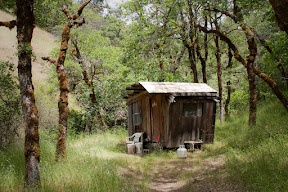
Hut, AbhayagiriAfter lunch, personal time begins, and I made use of it to sit in my humble cottage (called "The Bumblebee," and photo shown here) which was right next to a little babbling brook. My meditation practice was incredibly strong and deep, and I can't help but think that it was in part from the powerful energy of this monastery. From the moment I got there, I felt the peace overcome me. And, I had a wild dream on my second night there in which the entire universe exploded into shimmering lights of bliss, and I could see with incredible perspective on the total totalness of existence. It was cool, although I don't want to make too much a big deal out of it. The next day it was back to shoveling and breaking rocks. A flickering moment in time.

The trails (of which I helped work on) run for miles around the hills, which are mostly steep so provide ample exercise. I spent my last day running around taking photos and checking out the nooks and crannies.

They also have a pretty stellar library with a wide selection of Buddhist books and also some poetry, psychology, and even a cool book on old school etiquette.

Hills, AbhayagiriThe etiquette is another important point. When I first heard about Abhayagiri, my friend told me, "they are so careful with their vinaya there, it's impressive." The Vinaya is the monastic code of 227 rules governing all manners of morality and etiquette. I didn't really think that this could be impressive until I saw it! Yes, it is impressive!

It's not that they have really good rules, or that they are really good at keeping people from breaking the rules, or anything like that. In fact, most of the time it doesn't even feel like they are "rules" at all. Rather, it feels like an incredibly conscious community in which the monks take such care in all their actions. And with meticulous care, they cultivate a lifestyle which is incredibly pleasant to be around, peaceful, and joyful. Sure, there were a couple who seemed a little over-the-top with it, kinda like trying to be "good boy scouts." But, for the most part, it didn't seem contrived, forced, or oppressive at all. In fact, it felt freeing, open, and spacious. And, so many smiles too! The monks smile a lot.

Kitchen, AbhayagiriThe food is all donated (alms food), and it's not entirely vegetarian. The feast was quite large on Friday (the lunar celebration day) and I always made away with some very tasty dishes on my plate. Part of the practice is to only eat for health and not for pleasure, but it's a little counter-productive with all the cookies and dumplings, etc.

I made some good friends while there, and really enjoyed the company. I can see what a magnet this place must be for those who are willing to take the time to seek out such rare sanctuaries like this. I got to hear a couple short Dhamma talks from Ajahn Amaro and Ajahn Sucitto - two highly regarded long-time monks. The Dhamma talks brought me joy.

Alter, AbhayagiriOne reason I went was to see if I might someday want to become a monk. I must say that the trip brought me mixed thoughts on the topic. On one hand, I found the rules and monastic discipline to be more inspiring than what I'd thought. Also, the monk lifestyle seemed beautiful and very tempting. So, in some sense, I'm more interested now than before. While on the other hand, there was some thing about it also which pushed me away (and I'm not sure I can put my finger on it.) One of my friends noted that I'm a little too raw and unrefined for monastic life, and I think that may be it. I'm not a very "traditional" kind of guy, and I'm not a very good "Buddhist" either. But, we'll see. I have no idea what my future holds. I'm starting to think that I like my future like I like my coffee - with nothing in the cup. (I don't like coffee.)

Dhamma Hall, AbhayagiriI only stayed at Abhayagiri for three nights, as this was the plan with Robert and his driving schedule, and they limit your first stay to seven days max, anyway. I would like to go back at some point and stay for a longer time, perhaps. But, I'll be sure to be ready for some work!

Meditate... Do Not Delay.

"What should be done for his disciples out of compassion by a teacher who seeks their welfare and has compassion for them, that I have done for you, bhikkhus. There are these roots of trees, these empty huts. Meditate, bhikkhus, do not delay or else you will regret it later. This is our instruction to you."

- The Buddha

(Etched into a stone that lies among the hills at Abhayagiri Monastery)

It's Just a Tree!

Bodhi Tree - Bodh GayaSo, I'm still behind on my blog posting and photo uploads, so please enjoy them as they come. This one was from Bodh Gaya.

I sat under the Bodhi tree in Bodh Gaya... and... I'll be damned if I'm still not enlightened!

And you know what? It doesn't even yield magical fruits!

But, I'm a goofy American, and romantic at heart, so I'm not going to complain. I promise.

I did sit for an hour at the "contemplation spot" however, and had a great time. About halfway through my sit, a Thai monk came and sat nextto me and started chanting. There we sat, quietly engaged in our own practices. I felt a great sense of honor.

In Bodh Gaya, it's not unlikely to find yourself sitting at a cafe drinking a lassi with a Tibetan Rinpoche at the next table.

The town itself is rather small, flooded by the seasonal Tibetan pilgrims. I can only imagine how this village has changed from the queit forest solitude of 2500 years ago. Hopefully the devotion of the many many pilgrims will bring a little prosperity to the community into the future. And also the tourists who buy cool Buddha posters.

Anyway, I'm heading to Varanasi tomorrow. I will write more soon.

Bodh Gaya Retreats 2010

Wat Thai Monastery - Bodh GayaMy first sight when entering the Thai monastery was the brilliant gold temple that sits at the center of the complex. It's perhaps the most impressive temple of all the different traditions which have monasteries in Bodh Gaya (Japan, Nepal, Bhutan, Tibet, China, Myanmar, etc.) With the surrounding garden, kept finely manicured, it was an incredible backdrop for the retreat, and like a small teleport into Thailand itself.

Despite the welcoming temple garden, the accommodations were a bit more modest. Christopher Titmuss (the main instructor for the retreat and a former monk in Thailand) referred to the retreat facilities as "almost one-star." But, I've got to say, it was cleaner and quieter than most everything else in Bodh Gaya.

Check-in was at 2PM, and everything was quite straightforward. A group of western travelers, looking a bit weary from their adventures on the road gathered in front of the meditation hall for a first interview with the teacher. After that, we were given a tour and asked to find our spot in the dormitories.

The men were mostly put into the large basement underneath the temple itself! What an auspicious location to have monks chanting twice a day, and pilgrims coming to pay their respects - all just above our beds. We were each given a nice cot, a mosquito net, and a blanket, and everyone started to assemble their little nest.

We were shown the schedule, the dining area, and then left to settle in before that evening's opening talk.

Much of the garden and monastic complex was open for our wanderings, and also for our walking meditation throughout the course. There was even a rooftop terrace which gave a little peak out into the rest of Bodh Gaya, or a great place to enjoy the sunset.

The first 10 days were led by Rada Nicholson, who also co-lead the second 10 days with Christopher Titmuss. The teachings were diverse and rich with many different approaches, not only from Buddhism, but paying homage to much of the diverse Indian and Hindu contributions to spirituality. It's hard to put into a few words the teachings of 20 days, but I'll try my best to say a little bit.

If I were to sum up the teachings, I'd say that Rada's main message was simply to free the mind and find the state where death no longer exists - "no more coming and going." Perhaps it was a bit abstract. I just let the teachings sink in and rest in the depths of my mind wherever they landed.

I'd summarize Christopher's main message as "take a deep and genuine interest in life. No stone left unturned." I found this message to be incredibly inspiring and practical. The invitation was to really savor, explore and question every experience as it is, without placing any demand on reality to be anything other than simply reality.

But, of course, they said much more than that. The meditation techniques were based loosely on the Great Discourse on the Establishing of Mindfulness. The teachings were held loosely with the responsibility being on the meditator to find what's best for him or her. This was definitely different from my past experience with Goenka where he tells you exactly what to do and when, but I must say that now I have a great appreciation for both approaches. I can see the benefits of both, and I really appreciate how the greater freedom of this retreat actually sets a high bar for the meditator to be able to call on his own wisdom.

I think this was Christopher's aim: to encourage the meditators to become responsible and conscious human beings who don't need to rely on one technique, one teacher, or one instruction. But rather, that a conscious human being has the insight, the patience, and the wisdom to be able to navigate every circumstance of life in a fresh, creative, and lively way.

When the retreat began, we were given a thali plate to use for the whole retreat and the food was great. Porridge and bananas for breakfast every morning with a little variation, and about 4 different Indian dishes everyday for lunch. They served some fruit with tea in the evening, as well. And, lots of chai! It was all quite delicious, but after 20 days of Indian food, I'm ready for something a little different today.

The fellow retreatants were an interesting mix, and Christopher had to make a statement at the end explaining that it was actually a much different retreat than ever before. He referred to it as the "most unsettled retreat in 36 years of doing the Bodh Gaya retreats!"

People were having little whispers and conversations here and there. Couples were hanging out together. Some were reading books or doing paintings in the garden. Some took long naps with the puppies on the lawn. A few of the students got quite angry at the teachers at a few points. And to top it off, Radha's daughter got malaria at the beginning and nearly died in one of the monk's huts during the first 10 days. But, when it comes down to it, there's something about a retreat that makes it hard not to just love everyone else there. They are the Sangha - the brothers and sisters in practice. Nothing would be possible without the community.

I got pretty sick myself, with a high fever on day 2, and I spent most of days 3 and 4 in bed. Luckily, they had a nurse there who had volunteered to be the "medical manager" for the retreat, and they even had a couple cozy rooms reserved as sick rooms especially for us.

On day 4, a Hindi festival began and I awoke from a nap to blaring Bhangra music from a nearby sound system. I mean loud! Radha even decided to include it in a guided meditation on "just hearing, just listening." One of the many fun benefits of meditating in India. There were quite a few days of this music, as well as a parade that past by the monastery one afternoon, barking dogs, singing roosters, and more.

The animals were fun, but we were told that touching them was strictly forbidden, and for good reason. They were not clean, and I'd often see a dog vomiting on our walking paths, etc.

Perhaps one of the most inspiring parts of the retreat was the emphasis on Buddhism in action. They were insistent that we don't just sit on the cushion, but that we actually bring whatever wisdom we gain out into the world and share it with others. Christopher hit hard on topics like politics, economics, education, and false spirituality with hopes of shaking up our rigid world views a little.
Big Red FlowerIt wasn't just talk, however, they also introduced a number of local charities that have been greatly benefited by the retreatants over the years. When the retreat finished, I took part in some of the activities sponsored by these charities, so I'll write more about that soon. It was great to see this kind of community involvement, and I think it should be an inspiration for other meditation retreats worldwide to really question how they can benefit their community in more ways than just offering dhamma teachings.

There was a lot of love, and I felt inspired seeing how happy everyone on the retreat was amidst all the craziness of India.

I hope to go back someday for perhaps a more "settled" retreat, and I'd definitely recommend it to anyone else looking for a taste of the Dhamma at it's very source.

Know All Things To Be Like This...

What is this strange world we're living in? Strange, beautiful, bizarre, ordinary, simple, complex?

I've heard the following words of the Buddha before, but never knew where they came from. So, I decided that I had to find it and post it up here. I find it very inspiring. Supposedly, it comes from the Samadhiraja Sutra, which according to wikipedia, was written a few hundred years after the Buddha died. So, I don't know what that says about who the real author is, but who really cares?

Excerpt from The Samadhi Raja Sutra

Know all things to be like this:
A mirage, a cloud castle,
A dream, an apparition,
Without essence but with qualities than can be seen.

Know all things to be like this:
As the moon in a bright sky
In some clear lake reflected
Though to that lake the moon has never moved.

Know all things to be like this:
As people who have gone alone to mountain solitudes,
Or forests hear the echo of laughter, songs and weeping
But see not nor hear a thing.

Know all things to be like this:
As an echo that derives
From music, sounds and weeping,
Yet in that echo is no melody.

Know all things to be like this:
Just as you a dream enjoy
But when you wake see nothing
Only fools will yearn and hanker for this pleasure.

Know all things to be like this:
As a magician makes illusions
Of horses, oxen, carts and other things,
Nothing is as it appears.

Know all things to be like this:
A young woman in a dream
May see her son both born and dead.
Yet when he dies she is sad,
While at his birth she was overjoyed.

Know all things to be like this:
As at midnight the bright moon
Appears in water crystal-clear, yet
There is no moon and grasped it cannot be.

Know all things to be like this:
At noon in midsummer
A man by thirst torment, marching on,
Sees a mirage as a pool of water.

Know all things to be like this:
If in a mirage there's no water
Only fools will want to drink it,
For it can never be drunk.

Know all things to be like this:
If you split weeds to find their marrow,
You will always fail. In the same way
Within and without is nothing.

My Original Charcoal Paintings

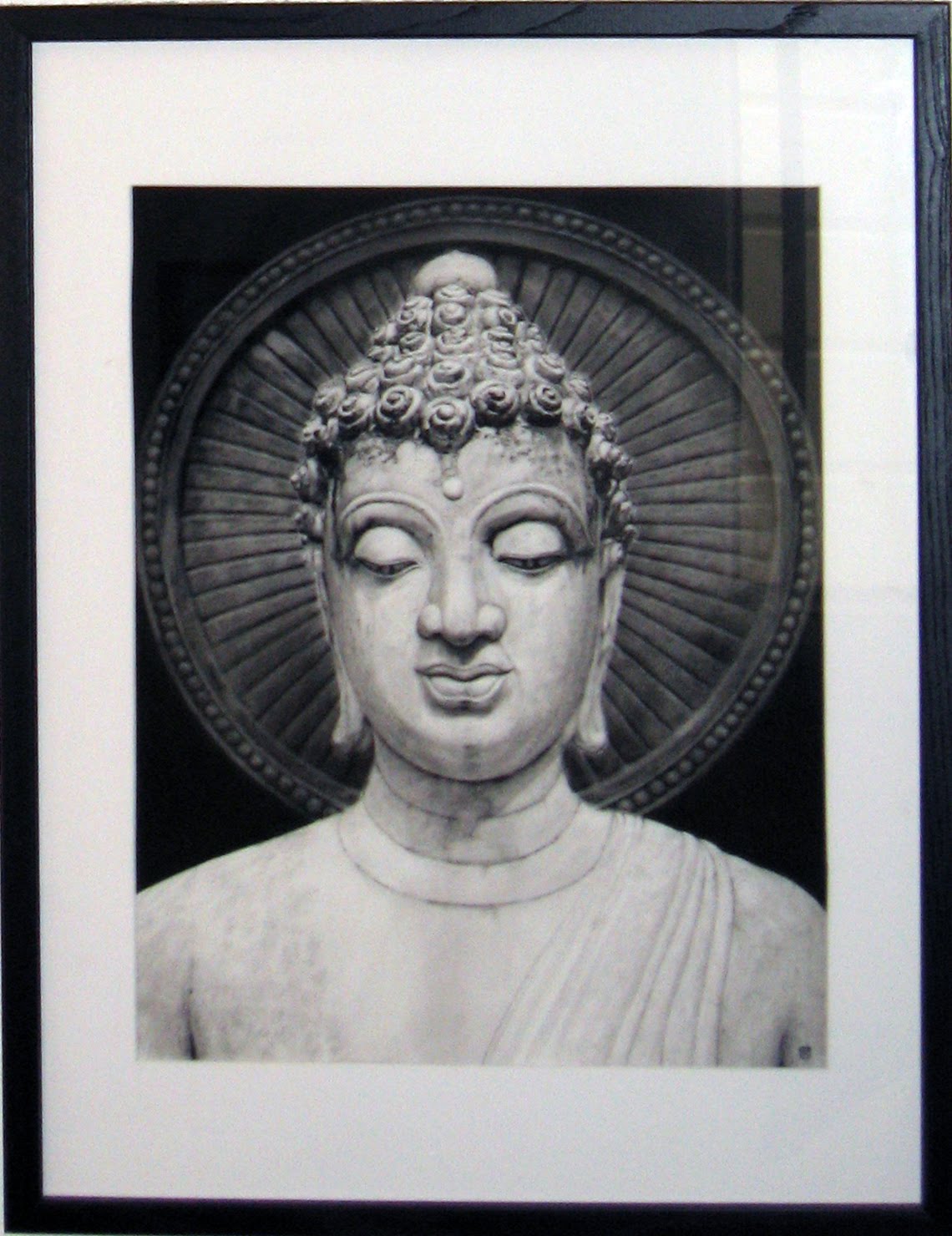
These are some of my charcoal paintings. I learned this technique in Thailand about 6 years ago, and most of the paintings were done after that. I haven't done much in a while, but I still love it.

These first paintings were original works based on photos I took:

Thai Buddha Sculpture Painting


These two were based on photos I got on the internet, but with my own artistic touch.


Marilyn Monroe Painting

These two were projects I was assigned from my teacher while I was doing my apprenticeship. You may recognize them as pretty famous photos (national geographic, I believe).


Afghan Girl Painting

Here's a photo of my teacher, and one of his works. He was incredible!